


When I first started helping families find the right person to look after their children, I learned one thing very quickly: it all comes down to trust. A huge part of building that trust begins with what we all still call a CRB check for working with children. You’ll hear that term a lot, but it’s officially been replaced by the DBS (Disclosure and Barring Service) check here in the UK. I like to think of it as the modern, more caring successor to an old but essential safeguard.
Your Essential Guide to Child Safeguarding Checks
Bringing a new person into your home to care for your children is one of the biggest decisions you’ll ever make. I know it can feel overwhelming. You aren’t just filling a vacancy; you’re placing your family’s safety and happiness in their hands. The vetting process can seem a bit intimidating at first, but once you understand what these checks are for, it all clicks into place. They’re designed to give you an impartial, official look at a candidate’s background, giving you the confidence you need to know they’re right for a role with your children.
My goal with this guide is to cut through the jargon and give you a clear, practical roadmap. I’m here to demystify the process and answer the real-world questions you have about your responsibilities in protecting the little ones in your life. The need for these rigorous checks is more pressing than ever, and for those in professional child care settings, they are an absolute must.
Why Safeguarding Is More Important Than Ever
The world of child protection is always adapting, and the latest figures really bring home just how critical this has become. Between 2015 and 2025, the number of children in care in England shot up by 23%, from 68,060 to 83,630. This sharp increase for me underlines the growing need for solid, reliable vetting for anyone who works with or around our children.
Building a Foundation of Safety
A DBS check is a fundamental part of doing your due diligence, but I always tell parents it’s just one piece of the puzzle. Real peace of mind comes from a holistic approach to vetting that also includes in-depth interviews where you trust your gut, checking references thoroughly, and making sure other crucial qualifications are in order.
“A certificate confirms a person’s history at a single point in time, but I truly believe a culture of safety is built on continuous vigilance, clear communication, and ongoing trust.”
For example, beyond the DBS check, it’s vital to verify a candidate’s practical skills. We cover another non-negotiable qualification in our article on the importance of paediatric first aid training, which is a must-have for any professional nanny. When you combine official background checks with confirming practical skills, you create a truly secure and nurturing environment right from the start.
Understanding The Different Levels of DBS Checks
When you’re responsible for a child’s safety, you quickly learn that not all background checks are the same. I find it helpful to think of it like this: the different levels of DBS checks are like different levels of security clearance. Each one opens the door to more sensitive information, and choosing the right one is your first and most important step in safeguarding.
Many people still use the old term ‘CRB check’, but that system was replaced years ago. It can be a little confusing, but this flowchart shows the simple switch.
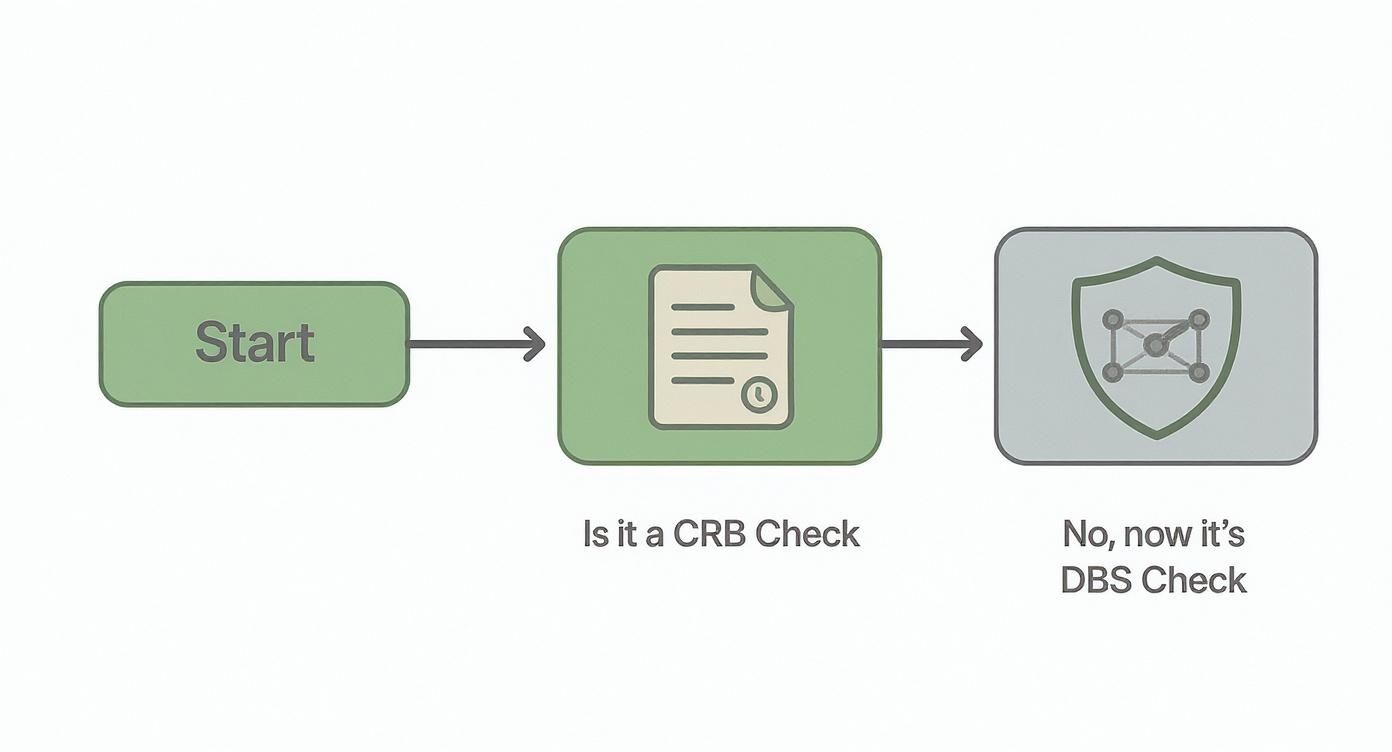
The main thing I want you to remember is that CRB checks are a thing of the past. The modern standard is the DBS check, and it’s vital to understand what each level really means for you and your family.
The Basic DBS Check: A Foundational Pass
At the entry-level, you have the Basic DBS check. This is the most straightforward of the three, providing a certificate that shows any ‘unspent’ convictions or conditional cautions. An ‘unspent’ conviction is simply one that hasn’t yet passed a specific time limit, after which it’s considered ‘spent’ and doesn’t need to be disclosed for most jobs.
Anyone can request a Basic check on themselves for any reason. But let me be perfectly clear: for any role involving direct work with children, a Basic check is completely inadequate. It’s a starting point, but it lacks the depth needed for such a trusted position.
The Standard DBS Check: A Deeper Look
One step up is the Standard DBS check. This search goes further and is reserved for specific roles, often in sectors like law or financial services.
A Standard check brings up a person’s full criminal history—that means both spent and unspent convictions, cautions, reprimands, and final warnings from police records. It paints a much clearer picture. Even so, it still doesn’t meet the rigorous demands for roles where someone is working closely with children.
The Enhanced DBS Check: The Gold Standard in Child Safety
This brings us to the Enhanced DBS check. This is the highest level of disclosure available and is the absolute mandatory requirement for anyone working with children. In my professional opinion, it’s the only real choice for a crb check working with children.
An Enhanced check includes everything a Standard check does, but it adds two crucial layers. First, it can include relevant non-conviction information held by local police forces. This might be intelligence that didn’t lead to a conviction but is still deemed relevant to whether someone is suitable for the role.
Second, for roles in schools or childcare, the Enhanced check must include a search of the Children’s Barred List. This is a critical step that confirms whether an individual is legally banned from working with children. This is a core part of the process we cover in our guide to Ofsted registration for nannies.
An Enhanced DBS check isn’t just a background check; it’s an active safeguarding tool. It accesses information that other checks don’t, providing the most complete picture possible to protect vulnerable individuals.
Here in the UK, the law is unambiguous: working with children requires an Enhanced DBS check. It’s the only way I can be sure that someone doesn’t have a history that could put a child at risk. To help you choose the right level, the table below breaks down exactly what each check includes.
Comparison of UK DBS Check Levels
| Feature | Basic DBS Check | Standard DBS Check | Enhanced DBS Check |
|---|---|---|---|
| Unspent Convictions & Cautions | Yes | Yes | Yes |
| Spent Convictions & Cautions | No | Yes | Yes |
| Police Warnings & Reprimands | No | Yes | Yes |
| Relevant Local Police Info | No | No | Yes |
| Children’s Barred List Check | No | No | Yes (if eligible) |
| Adults’ Barred List Check | No | No | Yes (if eligible) |
Ultimately, for any role involving children, the Enhanced DBS check is non-negotiable. It’s the only certificate that provides the comprehensive vetting needed to create a truly safe environment for your family.
The Children’s Barred List Explained
When you get an Enhanced DBS check for someone who will be working with your children, it’s not just about looking at their past criminal record. It’s about checking the single most critical safeguard in UK child protection: the Children’s Barred List.
This isn’t just another part of a background check. To me, it’s the definitive ‘do not hire’ list, a national register of individuals who are legally forbidden from working with children.

This list is actively maintained by the Disclosure and Barring Service (DBS) to ensure that anyone proven to pose a significant risk of harm can never get into a position of trust with a child. Checking it isn’t just good practice; it’s a non-negotiable legal duty for anyone hiring for a role in regulated activity with children.
How Does Someone End Up on the Barred List?
Getting placed on the Children’s Barred List is a serious step, reserved for cases where an individual’s behaviour poses a clear and ongoing threat. It doesn’t happen lightly and follows a strict, evidence-based process.
There are two main ways someone can be added:
- Automatic Barring: After a conviction for certain serious crimes against children, particularly those of a sexual or violent nature, the individual is automatically barred. There is no appeal against this. It’s an immediate red line.
- Referral Process: Organisations like schools, care providers, and nanny agencies have a legal duty to refer someone to the DBS if they were dismissed (or would have been) for harming a child or putting one at risk. This triggers a detailed investigation where the DBS weighs all the evidence, and the individual has a chance to make their case before a final decision is reached.
The Legal Implications for Families and Agencies
The law here is crystal clear for a reason. For any job that involves regulated activity with children, it is a criminal offence for an employer to knowingly hire someone who is on the Children’s Barred List.
This legal duty creates a powerful protective shield. It puts the responsibility squarely on you, the hirer, to carry out the correct level of crb check working with children—which is always an Enhanced DBS check that includes a barred list search.
“For me, the Children’s Barred List is the definitive line in the sand for child safeguarding. It moves beyond assessing past behaviour and makes a decisive, legally-binding judgement about future risk.”
This is precisely why an Enhanced DBS check is so much more powerful than a Basic or Standard one. It’s the only check that directly asks the system’s most important question: “Is this person legally prohibited from working with my children?”
Skipping this step isn’t just a lapse in judgement; it’s a serious legal breach with severe consequences, not just for you as an employer, but for the safety of the very children you’re trying to protect.
How to Navigate the DBS Application Process
Knowing the theory is one thing, but I know that actually managing the paperwork is where real confidence comes from. When it comes to a crb check working with children—specifically, the Enhanced DBS check—there’s one golden rule: an individual can’t just apply for one on their own. The request has to come from an employer or a registered organisation.
This is a deliberate safeguard. It’s designed to make sure these in-depth checks are only run for legitimate reasons, like protecting children. For a family looking to hire a nanny, this means you can’t just send your candidate a link to fill out a form. You have to go through an official channel, which I promise sounds more daunting than it actually is.

Working with an Umbrella Body
Since most families aren’t registered directly with the Disclosure and Barring Service, the most common route is to use a registered ‘Umbrella Body’. These are simply organisations that have been officially approved to submit DBS applications on behalf of others. I like to think of them as a secure go-between that manages all the admin for you.
A quick online search will bring up plenty of reputable Umbrella Bodies. They’ll provide the official application form for your candidate to complete, which asks for the usual personal details, a five-year address history, and, of course, their consent for the check to be carried out.
An Umbrella Body acts as your trusted agent in the DBS process. In my experience, they provide an essential layer of compliance and security, ensuring the application is correctly submitted and verified.
As the one doing the hiring, it’s your job to make sure the information on that form is accurate before it goes anywhere. And that leads us straight to the next crucial step.
The Identity Verification Stage
Before any application is sent off to the DBS, the candidate’s identity has to be confirmed beyond any doubt. It’s a non-negotiable step to prevent fraud. The Umbrella Body you choose will give you clear instructions on which documents are needed, but it always involves checking a specific mix of original documents.
The process is broken down into “routes”:
- Route 1: This is the preferred and most straightforward path. It requires one document from Group 1 (like a current passport or driving licence) plus two more documents from a wider list that includes birth certificates, bank statements, or utility bills.
- Route 2 & 3: If a candidate can’t meet the Route 1 requirements for any reason, there are alternative routes that require a different combination of documents.
You, or someone you designate, must physically see and handle these original documents to validate them. It’s a meticulous task, but I believe it’s the bedrock of a trustworthy check. Some Umbrella Bodies now also offer digital ID verification services, which can certainly speed things up.
Managing International Candidates
So, what happens if your perfect candidate has lived or worked overseas? A UK DBS check only covers their time in the UK, leaving a potential gap in their history. This is a very common scenario and one that needs careful handling.
For anyone who has spent significant time abroad (typically six to twelve months or more), you must ask for an international background check from every country they’ve lived in. This is often called a ‘Certificate of Good Conduct’ or something similar.
While it’s the candidate’s responsibility to get this paperwork, it’s your responsibility as the employer to insist on it. Without it, you’re flying blind. From my perspective, a candidate’s attitude towards getting these checks for you is also very telling—true professionals understand it’s part of the territory and will be completely transparent. Aspiring nannies can see the high standards we expect when they begin the nanny registration process.
Timelines and Receiving the Certificate
Once the properly verified application is submitted, the waiting game begins. Many checks come back within 14 days, but don’t be surprised if some take longer. If an application is complex or has to be passed between several police forces, delays can happen.
The final certificate is posted directly to the applicant’s home address—not to you. You must then ask to see the original, physical certificate to verify the result before their first day of work.
Going Beyond the Certificate: Advanced Vetting in Practice
Meeting the legal minimum for a DBS check isn’t the finish line; it’s the starting block. For families and agencies like ours who prioritise the absolute highest standards of safety, a paper certificate is just one piece of a much larger puzzle. It’s about creating a culture of vigilance where safety is an ongoing commitment, not a one-off task.
This proactive mindset ensures you’re not just ticking a legal box, but are actively building the most secure and positive environment possible for the children in your care. For me, it means looking beyond official documents to understand the subtle, human qualities that truly define a trustworthy candidate.
The Power of Continuous Vetting
A standard Enhanced DBS certificate is essentially a snapshot in time. It tells you about a person’s criminal record up to the day it was printed, but it doesn’t automatically refresh with new information. To solve this very problem, the Disclosure and Barring Service introduced the DBS Update Service.
I believe subscribing to this service is a genuine game-changer for child safeguarding. It keeps a candidate’s DBS certificate ‘alive’ by allowing employers (with the applicant’s consent, of course) to perform instant online status checks. This means you can be alerted to any new information that might change their suitability for working with children, transforming the check from a static piece of paper into a dynamic, ongoing safeguard.
A DBS certificate tells you where someone has been. The Update Service tells you where they are now. It is the bridge between historical data and real-time peace of mind, making it an essential tool for elite household staffing.
Making registration with the Update Service a non-negotiable requirement is a clear sign of best practice. It shows a mutual commitment to transparency and ongoing safety that goes far beyond just meeting the basic legal threshold.
Reading Between the Lines in Interviews
While the DBS check handles a person’s past, the interview is where you assess their present character and suitability. A certificate can’t tell you about someone’s temperament, their judgement under pressure, or their communication style. These are the crucial soft skills you have to evaluate for yourself, and where your parental intuition is invaluable.
During interviews, I always advise parents to focus on situational questions that reveal a candidate’s true instincts and values:
- Scenario-Based Questions: Ask “What would you do if…” questions that cover discipline, emergencies, or unexpected situations.
- Attitude Towards Safeguarding: Bring up the topic of safeguarding directly. A professional, high-calibre candidate will welcome this discussion and show they grasp its importance.
- Emotional Intelligence: Pay close attention to how they interact, listen, and respond. Do they come across as patient, empathetic, and calm?
These conversations give you invaluable insights that a formal check can never provide, helping you build a much more complete picture of the person you’re considering. To add another layer of certainty and combat potential identity fraud, many organisations are now exploring advanced solutions like biometric identity verification methods.
The Art of the Thorough Reference Check
Reference checks are your final, and often most revealing, layer of due diligence. It’s so important not to treat them as a simple tick-box exercise. A thoughtful, unscripted conversation with a previous employer can uncover subtle details about a candidate’s reliability, professionalism, and, most importantly, their interactions with children.
I always prepare a few specific, open-ended questions before I call:
- Could you describe their approach to setting boundaries and handling discipline?
- How did they cope with stressful or challenging situations involving the children?
- Would you re-hire them without any hesitation? (The pause before they answer this one can tell you everything.)
This kind of detailed vetting is especially critical when you consider just how many children are in formal care. For example, in 2025, government statistics showed that around 91% of eligible 3- and 4-year-olds were registered for funded early education. That figure underscores the immense number of professionals we entrust with our children’s wellbeing every single day. You can find more on these early education trends from the Department for Education.
Your DBS Check Questions, Answered
Even with a good grasp of the basics, some practical questions always pop up when you’re in the middle of the hiring process. Let’s tackle some of the most common queries I hear from families about the crb check working with children.
How Long Is A DBS Check Valid For?
This is the number one question I get, and the answer can be a bit of a curveball: technically, a DBS certificate has no official expiry date. Think of it as a photograph; it’s a perfectly accurate snapshot of a person’s criminal record on the exact day it was printed.
Of course, a photo from five years ago isn’t much use today. That’s why the certificate becomes less reliable over time. This is precisely why the DBS Update Service is so important. It turns that static photo into a live video feed, allowing you (with the applicant’s permission) to check for any new information in real-time. For anyone working with children, an annual check using the Update Service is the absolute gold standard.
Can Volunteers Get A DBS Check?
Yes, and they absolutely should. Anyone, paid or not, who is involved in regulated activity with children is eligible for an Enhanced DBS check.
The good news is that the DBS waives its own fee for genuine volunteers. The Umbrella Body processing the application will still have a small admin charge to cover their work, but this makes proper safeguarding accessible for everyone from the local scout group to school trip chaperones.
Safeguarding isn’t just for paid professionals; it’s a fundamental duty for anyone looking after children. I’m glad the DBS system is set up to remove cost as a barrier to keeping kids safe.
What Happens If A Certificate Reveals Past Offences?
Finding something on a DBS certificate can feel daunting, but it doesn’t automatically mean you have to rule the person out. The crucial next step is to assess the information fairly and thoughtfully, with your child’s safety as your unwavering focus.
You need to look at the whole picture. When a disclosure comes back with information, I recommend considering these points:
- What was the offence? Is it relevant to a childcare role? A minor driving offence from ten years ago is very different from something involving violence or dishonesty.
- When did it happen? A youthful mistake made long ago carries different weight than a recent conviction.
- Is there a pattern? Was this a one-time error in judgment, or does it suggest a behavioural pattern?
This is where a frank, non-judgemental conversation with the candidate is essential. Their perspective can provide the context you need to make a sensible, informed decision. The final call is yours, and it must always be guided by a careful risk assessment centred entirely on protecting your child.
At Superstar Nannies, we navigate these complexities every day, ensuring every candidate undergoes the most rigorous vetting process. Find your perfectly matched and thoroughly vetted nanny today.