
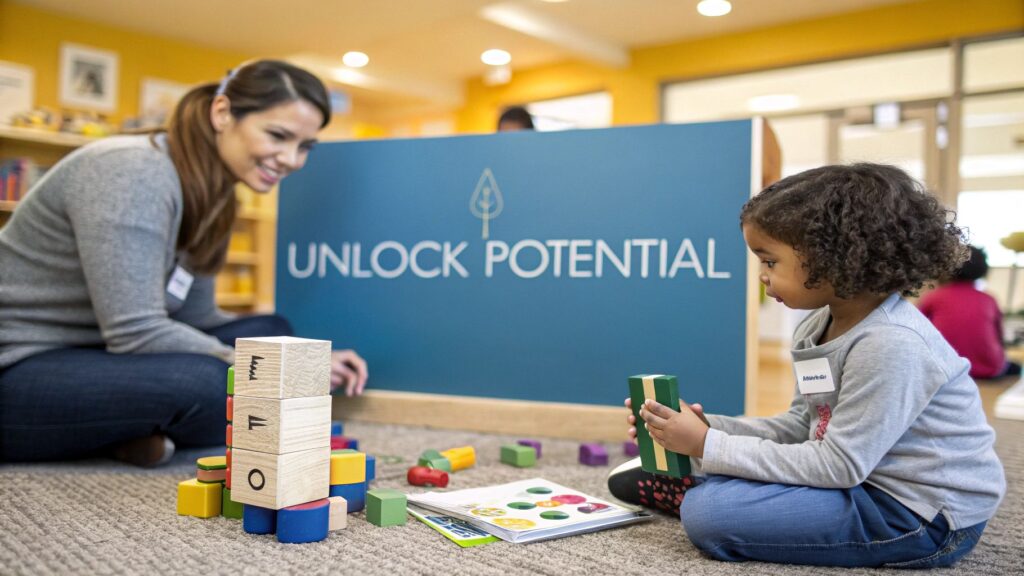
When I first started in early childhood education, I thought it was about teaching letters and numbers. It took watching my first charge, a little boy named Sam, figure out how to stack three wobbly blocks for the first time—the sheer focus in his eyes, the triumphant laugh when they didn’t fall—for me to understand. The real significance of early childhood education isn’t about academics; it’s the architect of a child’s entire future. During those first five years, their brain is a whirlwind of creation, laying down the fundamental pathways for how they’ll learn, behave, and feel for the rest of their lives. Those early moments truly set the stage for everything that follows.
Why Early Education Is a Child’s Foundation
Think of it like building a grand house. You wouldn’t skimp on the foundation, would you? The strength of that initial framework dictates how tall, stable, and resilient the final structure can be. Early childhood education plays this exact role for a developing human. It’s the essential groundwork for a happy, successful, and well-adjusted life. I’ve seen it time and again; this isn’t just a ‘pre-school’ phase—it’s the most critical construction period for a person’s cognitive and emotional architecture.
The years from birth to age five are an incredible window of opportunity. In this short time, a child’s brain forges more than one million new neural connections every second. These connections are the very bedrock of all future learning, from grasping complex ideas to navigating nuanced social situations.
More Than Just Learning ABCs
While learning letters and numbers is a wonderful outcome, I’ve learned that the true value of early childhood education runs much deeper. It’s about nurturing the whole child. A high-quality learning environment, whether that’s a top-tier nursery or at home with a dedicated nanny, focuses on key developmental areas that shape a person for life.
These foundational pillars include:
- Cognitive Skills: Fostering problem-solving abilities, natural curiosity, and a genuine love for learning through purposeful play.
- Social Competence: Learning how to share, cooperate, and communicate with both peers and adults.
- Emotional Resilience: Building the ability to understand and manage feelings, cope with frustration, and develop empathy.
This holistic approach is absolutely vital. Study after study confirms that children who experience high-quality early education are more likely to do better academically, earn more as adults, and lead healthier lives.
The investment in early learning is one of the most effective ways to build a thriving society. For every £1 invested, the return can be as high as £13, benefiting not just the child but the entire community through improved economic and social outcomes.
The Evolving Landscape of Early Learning
Our modern understanding of these formative years is a world away from what it was a generation ago. We’ve moved beyond seeing it as simple childcare and now recognise it as a deliberate, science-backed approach to human development. To really appreciate its importance today, it’s worth looking at how early childhood education has evolved over the years.
This shift acknowledges that every single interaction—every story read, every block stacked, every question patiently answered—helps build a stronger, more capable mind. From my own experience, I can tell you that for families who want the absolute best start for their children, investing in these early years provides the single most powerful advantage for their future, setting them on a trajectory for lifelong success and fulfilment.
How Early Learning Builds a Better Brain
I love to think of a child’s brain in their first five years as a bustling construction site. Every new sight, sound, and sensation is a building block, laying the foundation for the mind’s entire architecture. This isn’t just a period of growth; it’s a time of intense, strategic development, and early education provides the expert blueprint for building a smarter, more capable brain.
Simple, playful activities are, in reality, high-impact workouts for a child’s developing neural network. When a toddler carefully stacks blocks, they’re doing far more than just playing. They’re honing spatial awareness, practising problem-solving, and mastering fine motor control. Listening to a story isn’t just entertainment; it’s a powerful exercise that expands vocabulary and wires the brain for a lifetime of literacy.
These “workouts” are so important because they forge strong, efficient connections between brain cells. It’s a bit like building a new city’s road system. The more a particular road is used, the wider and faster it becomes. In the same way, every time a child figures out a puzzle or sings a new song, they strengthen a specific neural pathway. This makes it easier for their brain to access that skill or piece of information later on.
The Science of Cognitive Growth
Cognitive development is essentially the process of building the mental toolkit a person needs to think, read, and learn. Early experiences are the raw materials for this construction project. During these critical early years, the brain is incredibly pliable—a quality scientists call neuroplasticity. This means a child’s experiences are literally, physically, shaping the structure of their brain.
A rich learning environment provides exactly the right kind of stimulation to make the most of this period. It sparks curiosity and encourages exploration, which are the real engines of learning. As an educator, I know that a child who is encouraged to ask “why?” and is guided to discover the answer is actively building the circuits for critical thinking and reasoning. These are the foundational skills that pave the way for future success in everything from maths to science.
A child’s brain develops more in the first five years than at any other point in their life. In fact, research shows that 90% of a child’s brain develops by age five, highlighting the critical window of opportunity that high-quality early education provides.
From Play to Problem-Solving
The line from playful exploration to sophisticated problem-solving is surprisingly direct. The skills a child picks up during structured play become the very foundation for academic achievement and a genuine love of learning.
Here’s a glimpse of how everyday activities translate into essential cognitive skills:
- Puzzles and Sorting Games: These teach pattern recognition, categorisation, and logical reasoning—the bedrock of mathematical thinking.
- Creative Play and Art: Drawing, painting, and make-believe games foster creativity, planning, and self-expression. Engaging in fine motor skills development activities for kids is vital for both physical and cognitive growth, helping to lay down the neural pathways that support all future learning.
- Storytelling and Reading: This builds a powerful foundation for literacy by expanding vocabulary, improving concentration, and developing a child’s ability to understand and follow a narrative.
This is where a specialist nanny truly shines. They can turn these ordinary moments into extraordinary learning opportunities. By observing a child’s unique interests, they can tailor activities that challenge and engage them, creating a personalised ‘brain-building’ curriculum on the fly. Instead of sticking to a rigid plan, they can adapt in the moment, turning a fascination with garden bugs into a lesson on biology, or a love for building towers into an introduction to engineering. For more ideas, our guide on stimulating activities in nurseries offers excellent examples that can be perfectly adapted for a one-on-one environment.
This bespoke approach ensures a child isn’t just memorising facts, but is truly learning how to learn—a skill that will serve them for the rest of their lives. By nurturing their innate curiosity within a supportive and stimulating home environment, a dedicated educational partner helps construct a truly exceptional mind, one ready for any challenge the future holds.
Nurturing the Heart: The Power of Social and Emotional Skills
While we often focus on academic milestones and cognitive growth, they’re only half the story. The true foundation for a confident, resilient, and fulfilled adult is built with social and emotional skills. Early childhood is the first and most critical laboratory for this learning, where little ones start to make sense of the complex world of feelings, friendships, and self-control.
Picture two toddlers, Amelia and Leo, both reaching for the same bright red toy car. It’s a classic playground dilemma I’ve seen a hundred times, but in that simple moment, a universe of learning is about to unfold. Their first impulse might be to just grab it, leading to the usual tears and frustration. A high-quality early learning environment, however, turns this everyday conflict into a powerful lesson in social and emotional learning (SEL).
This is all about helping children navigate their inner world and connect with others. It’s giving them the tools to manage big emotions, see things from someone else’s perspective, and build positive relationships. Honestly, these skills are far better predictors of lifelong happiness and success than knowing the alphabet ahead of schedule.
The First Social Laboratory
For a young child, a nursery or playgroup is their first society outside the family. It’s where they meet peers who want different things, think differently, and have entirely different personalities. This dynamic is the perfect training ground for developing skills they’ll use for the rest of their lives.
Let’s go back to Amelia, Leo, and that red car. With the right guidance, this squabble becomes a masterclass in:
- Empathy: Realising the other person has strong feelings about the toy, too.
- Negotiation: Figuring out how to take turns or inventing a new game they can play together.
- Managing Frustration: Learning to cope with the disappointment of not getting what you want, right now.
- Communication: Using words to explain what they feel, instead of just grabbing or crying.
These might seem like small wins, but they are monumental steps in building emotional intelligence. This ability to understand and manage your own emotions—and to recognise and influence the emotions of others—is a cornerstone of leadership, strong relationships, and personal well-being.
Social and emotional skills are the invisible architecture of a well-adjusted person. They provide the internal framework for confidence, resilience, and mental wellness, proving the immense early childhood education importance in shaping a child’s character.
The Role of an Educationally-Focused Nanny
While group settings create the opportunities for these interactions, it’s the guidance from a skilled adult that makes the lessons stick. An educationally-focused nanny truly shines here, acting as a child’s personal coach for emotional intelligence. They don’t just watch over playtime; they actively shape it.
When I see a conflict over a toy car erupt, I know it’s a teaching moment. A professional nanny can step in to model a better way. They can put words to the children’s feelings—”I can see you both really want that car, and it feels frustrating to wait”—before guiding them toward a solution. This one-on-one attention is incredibly powerful, offering support that’s perfectly timed and tailored to the child’s specific needs.
The UK’s commitment to this area is crystal clear. The government’s Early Years Education Recovery (EYER) programme has supported over 68,000 individual practitioner training opportunities as of March 2025. This initiative is designed to strengthen support for social skills and language development, with nearly 48,000 children having completed language assessments through targeted interventions. This national investment highlights just how valuable high-quality, guided learning is. You can discover more about the UK’s early years recovery initiatives on the government’s official statistics site.
By providing consistent, compassionate guidance during these pivotal moments, a nanny nurtures a child’s emotional literacy right from the start. They ensure the child develops the strong heart and steady mind needed to navigate life’s challenges with grace and confidence. This dedicated partnership builds a foundation not just for school, but for a lifetime of meaningful relationships.
The Power of Words: Language and Communication
From the moment a baby coos, they are beginning to build their world with words. This early journey isn’t just about learning to talk; it’s about constructing the entire framework for their thoughts, feelings, and ideas. I’ve always said that a home filled with rich, responsive language provides the raw materials a child needs to build a bright and articulate mind.
It’s fascinating to watch the two sides of language develop. You have receptive language, which is everything a child understands, and then there’s expressive language—the words they can actually use. A toddler might follow a complex instruction like, “Please put the blue teddy in the toy box,” long before they could ever string that sentence together themselves. The real magic happens in closing that gap through constant, meaningful interactions.
These back-and-forth conversations are the lifeblood of communication. Singing songs together, reading stories aloud every day, and simply chatting about what you see are incredibly powerful ways to wire a child’s brain for a lifetime of literacy and confident self-expression.
This infographic captures the profound, long-term impact of high-quality early childhood education, showing how these foundational skills translate directly into measurable success later in life.
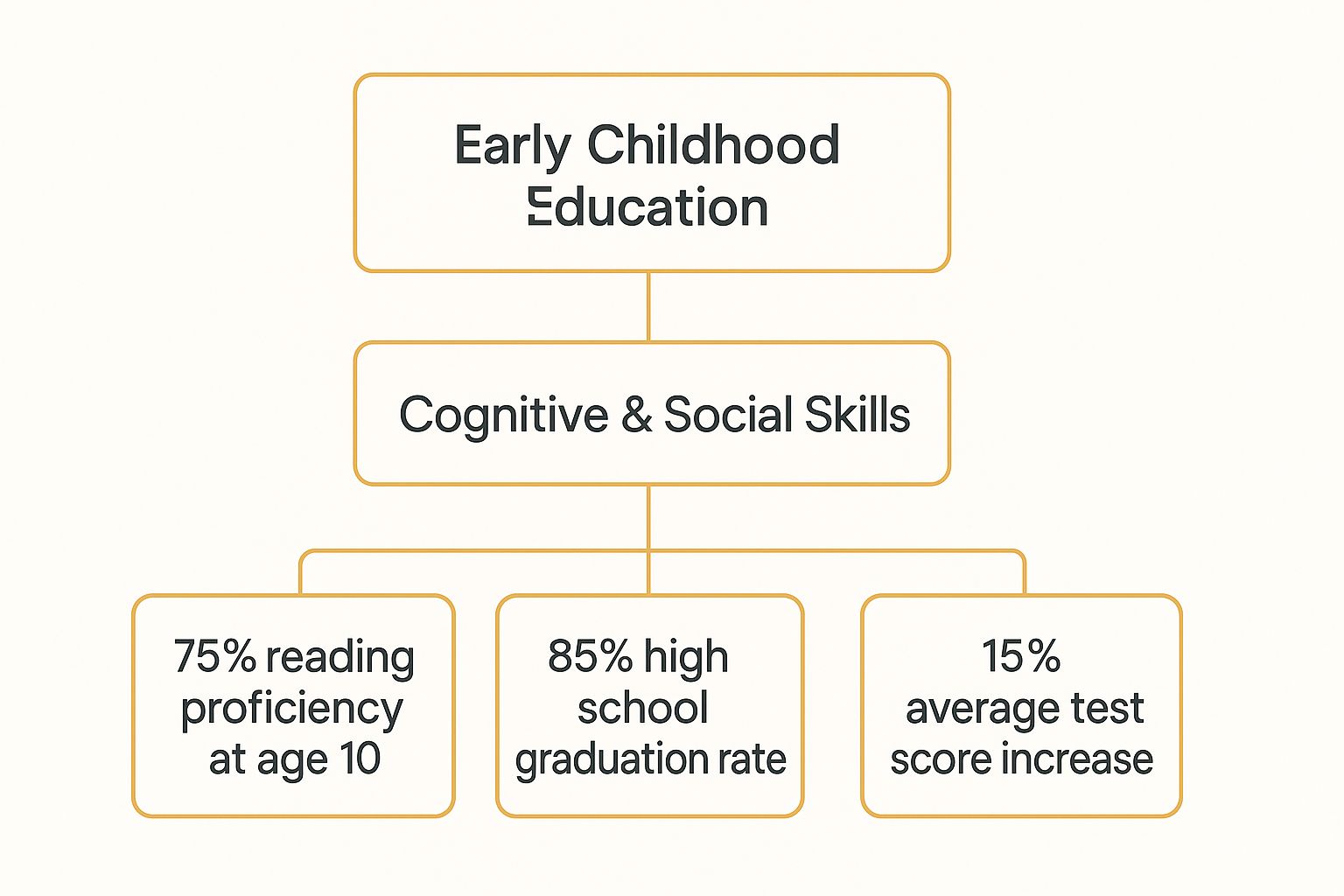
As you can see from the data, these benefits aren’t just abstract concepts. They show up in tangibly better reading skills, higher graduation rates, and stronger academic performance across the board.
More Than Just Talking
True communication is a dance, a two-way exchange. It’s as much about listening and understanding as it is about speaking. High-quality early interactions are where children learn these vital, often-overlooked skills.
Through guided conversations, a child learns how to:
- Listen actively: Really paying attention when someone else is speaking.
- Interpret non-verbal cues: Understanding that a smile, a frown, or a pointed finger all carry powerful meaning.
- Take turns in conversation: Getting a feel for the natural rhythm of a dialogue.
- Share their ideas with confidence: Feeling safe and encouraged enough to voice their thoughts and endless questions.
This foundation is everything. A child who can clearly express their needs and truly understand others is far better equipped to build friendships, navigate disagreements, and engage curiously with the world.
Every conversation with a young child is a brick being laid in the foundation of their future literacy. The back-and-forth exchange, often called “serve and return,” is scientifically proven to build stronger neural connections in the parts of the brain responsible for language and communication.
The Nanny as a Dedicated Language Partner
For families seeking an exceptional start for their child, a professional nanny is so much more than a caregiver; they are a dedicated language partner. Their primary role is to create a continuous stream of the high-quality verbal interactions that we know are essential for building a robust vocabulary and a sophisticated mind.
Think about a simple trip to the park. An elite nanny doesn’t just push the swing; they narrate the world. They’ll say things like, “Look how high you’re swinging! Can you feel the wind on your face?” or, “I see a big, fluffy white cloud up there. It looks just like a sheep.” This running commentary wraps the child in a rich tapestry of words, connecting language directly to their immediate, sensory experiences.
This is where the one-on-one attention becomes so powerful. Unlike in a busy group setting, a nanny can tailor every conversation to the child’s current interests and developmental stage. They can pause to answer every single “why,” expand on a child’s simple observation with more descriptive words, and introduce new vocabulary in a completely natural, unforced way.
This consistent, personalised language immersion is one of the greatest advantages for nurturing an articulate and curious communicator, perfectly illustrating the early childhood education importance in the fabric of daily life.
Why the UK Puts Such a Big Emphasis on the Early Years
In the United Kingdom, early learning isn’t just a nice-to-have; it’s a national priority. This deep-rooted commitment, backed by government policy and sky-high participation rates, offers a powerful endorsement of just how crucial these first few years are. When you understand this national consensus, it really frames the value of investing personally in your child’s formative development.
When a government goes to great lengths to provide a baseline for every child, it sends an unmistakable signal. This nationwide strategy confirms that high-quality educational experiences before school are not a luxury, but a fundamental building block for a successful future and a healthy society.
You can see this philosophy in action through the UK’s universal entitlement policies. In fact, enrolment rates for three- and four-year-olds here are some of the highest in the world, with both age groups hitting a remarkable 100% participation rate. This robust system is built on a government policy that provides all three- and four-year-olds with a funded, part-time early education place, guaranteeing access for everyone. For a closer look at the data, you can explore the full OECD education report.
Building on a Strong Foundation
This universal standard creates a fascinating opportunity for discerning parents. If the national policy sets a solid baseline for all children, a personalised, one-to-one approach represents the absolute pinnacle of that investment. It takes a proven, nationally-endorsed concept and elevates it to an exceptional level.
By choosing an educationally-focused nanny, you are essentially building upon this strong foundation. You’re providing a bespoke educational journey that goes far beyond a standard curriculum, tailored precisely to your child’s unique pace, personal interests, and emerging personality.
This approach transforms early education from a group activity into a personal development partnership. It honours the national consensus on its importance while delivering it in the most focused and impactful way imaginable.
This elevated standard ensures a child isn’t just meeting developmental milestones but is truly thriving. It makes the transition into formal schooling feel much smoother and more confident because they’ve already had a rich, guided introduction to the joys of learning. Preparing for that step is crucial, and our guide on getting ready for the first day at nursery has some great insights that can be adapted for any new environment.
A Personal Commitment to Excellence
Ultimately, the UK’s focus on early years education provides a clear benchmark for what excellence looks like. It validates the decision of parents who want to give their child a significant head start in life.
By investing in a professional who can deliver a curriculum at home, families ensure their child receives:
- Undivided Attention: Every question is answered, every moment of curiosity is nurtured.
- Customised Learning: Activities are designed around the child’s specific interests, making learning feel like pure play.
- Consistent Guidance: A single, trusted educator offers stable and reliable support through key developmental stages.
This personal commitment reflects a deep understanding of what the national data already proves: these early years are profoundly important. Choosing to maximise this critical window with dedicated, one-on-one support is the most direct way to ensure your child’s foundation is not just strong, but exceptional.
The Nanny as a Personal Development Partner
We’ve talked a lot about the science of brain development and the art of building social skills. It’s clear that those early years are incredibly important. But knowing why something matters is one thing; putting that knowledge into practice is another challenge entirely. This is precisely where a highly qualified nanny steps beyond the role of a caregiver to become a child’s dedicated development partner.
Think of them as a private tutor for life itself. They’re uniquely placed to craft a completely bespoke curriculum that’s woven into the very fabric of your child’s day, not just ticked off a classroom schedule. This living, breathing educational plan adapts in real-time. A sudden fascination with ladybirds in the garden becomes a vibrant, hands-on biology lesson. A rainy afternoon indoors turns into an engineering challenge with building blocks.
This one-to-one, personalised approach is the gold standard. It ensures a child’s natural curiosity is always the engine driving their education forward.
From Theory to a Thriving Child
Take the Harrison family, one of our clients. Their four-year-old, Thomas, was a bright boy but incredibly shy in group situations. They hired a nanny with a background in early years education and saw an amazing shift. The nanny didn’t force him into social settings; instead, she designed activities that gently stretched his comfort zone. They might prepare a little “show and tell” just for his grandparents or create stories together where Thomas was the brave hero.
Within six months, Thomas wasn’t just more confident—he’d developed a deep-seated love for learning. His story shows perfectly how a one-to-one partnership can target specific developmental needs, nurturing both intellect and character with real precision.
A professional nanny is a catalyst, turning everyday moments into powerful learning opportunities. They don’t just follow a developmental checklist; they actively cultivate the skills, confidence, and resilience a child needs to flourish.
The Ultimate Investment in Your Child’s Future
The value of early education isn’t just a niche belief; it’s becoming a national priority. Look at the UK government’s plan to expand funded childcare, for instance. By September 2025, many working families will be eligible for 30 hours of funded childcare each week for children as young as nine months old. You can learn more about the UK’s funded early education entitlements to see the full scope.
This growing national consensus highlights a crucial point: if the standard provision is becoming this robust, a truly personalised approach offers an even greater advantage. Choosing the right path can feel complex, and our detailed comparison of the benefits of a nanny versus a nursery offers more clarity on this.
Ultimately, bringing a nanny on board as a development partner is more than just childcare. It’s a strategic choice to give your child the most focused and exceptional start in life.
Frequently Asked Questions
Stepping into the world of early childhood education can feel a little overwhelming, and it’s only natural for parents to have questions. You want to give your child the very best start, after all. Here, we’ve tackled some of the most common queries we hear from families like yours, offering straightforward insights to help you feel confident in your decisions.
When Is the Right Age to Start Early Learning?
The truth is, learning doesn’t start on the first day of nursery—it begins at birth. What matters most isn’t a magic number on a calendar, but the quality of a child’s environment and interactions from their very first days. Think of it as building with blocks: every playful, age-appropriate interaction is another block in the foundation of their development.
While many people think of “schooling” starting around age two or three, a truly exceptional nanny weaves learning into daily life right from the beginning. Every nappy change, every feeding, every walk in the park becomes a moment for connection and discovery. This way, learning feels like a natural part of life, not something that happens on a schedule.
Can a Nanny Provide Enough Social Interaction?
This is a big one for many parents, and it’s a valid concern. But I always encourage them to look at quality over quantity. True socialisation isn’t just about being in a room with other children; it’s about learning how to build relationships, share, and navigate feelings with a trusted guide. This is where a professional nanny truly shines.
They don’t just facilitate social time; they curate it.
- Structured Playdates: They can organise one-on-one or small group playdates with clear, gentle goals, like taking turns with a favourite toy.
- Community Classes: Attending a music or tumbling class allows a child to interact with others in a new environment, all with their trusted caregiver right there for support.
- Guided Outings: A simple trip to the local library or market becomes a real-world lesson in observing social cues and interacting politely with others.
This kind of focused coaching provides a masterclass in empathy and cooperation that’s often diluted in a larger group setting. It builds social skills that are deep and lasting.
What Qualifications Matter for an Educational Nanny?
When you’re looking for a nanny to champion your child’s early development, there are a few things that are simply non-negotiable. Of course, you’ll want to see formal qualifications, like a degree in Early Childhood Studies or a Cache Level 3 diploma. These credentials prove they have a solid understanding of the theory behind child development.
But theory is only half the story. Real-world experience is where the magic happens. I always tell families: don’t just look at a CV; dig deeper in the interview. Ask scenario-based questions like, “How would you help a toddler work through their frustration with a tricky puzzle?” Their answer will tell you more about their patience, problem-solving skills, and personal touch than any certificate ever could.
At Superstar Nannies, we connect families with exceptional, vetted professionals who do more than care—they educate, nurture, and inspire. Discover the difference a personal development partner can make for your child.
Find your perfect match at Superstar Nannies.