

I’ll never forget the first time my toddler choked. It was a quiet Tuesday afternoon, the culprit a tiny piece of apple. One second he was giggling, the next, his eyes were wide with a silent, terrifying panic. That heart-stopping moment, which thankfully ended with a few forceful back blows and a whole lot of tears (mostly mine), was my wake-up call. This is where paediatric first aid stops being a concept and becomes the most important skill you’ll ever learn. It’s what helps you push past that raw fear and take clear, life-saving action for your child.
Why Paediatric First Aid Matters More Than You Think
Learning these skills isn’t about memorising a textbook; it’s about building the quiet confidence to be your child’s first responder. For me, it was about being ready to act calmly and correctly when every single second felt like an eternity.
Our children are fearless explorers, but their coordination is still a work in progress, making them magnets for accidents. The hazards are everywhere, from a small toy lodged in their throat to an unexpected tumble from the sofa.
The real power of paediatric first aid isn’t just knowing what to do. It’s having the self-assurance to stay calm, take control, and provide vital care and comfort when your child needs you most. I can tell you from experience, that calm is contagious.
This kind of preparation is priceless, providing a peace of mind that can turn your own fear into focused, effective action.
Beyond Bumps and Scrapes
When I first thought about “first aid,” I pictured plasters and antiseptic wipes. But the reality, especially with our children, goes so much deeper. The skills you learn are critical for spotting and responding to serious medical emergencies long before a paramedic can get to you.
Understanding how a child’s body works is absolutely key. Their airways are smaller, their metabolism is faster, and their skin is more delicate. This means they react very differently to injuries and illnesses than we do. A high temperature or a minor burn can escalate into something serious far more quickly in a little one.
For anyone navigating the wonderful but chaotic world of young children, having these skills is non-negotiable. It goes hand-in-hand with all the other parenting challenges, and learning strategies for keeping up with an active baby only reinforces how quickly things can happen.
This guide will walk you through the essentials, empowering you to handle common accidents and, crucially, recognise the signs of a true emergency. For families who require more specialised, ongoing medical attention, preparedness might look a little different. Many find incredible reassurance in dedicated support, and understanding the role of a private medical nurse for your little ones is a great example of how this peace of mind can be woven into daily life.
Ultimately, taking the time to learn paediatric first aid gives you:
- Real Confidence: The ability to assess a situation calmly and act decisively, without hesitation.
- Better Outcomes: Quick, correct intervention can dramatically reduce the severity of an injury and prevent later complications.
- The Power to Save a Life: In critical moments involving choking, seizures, or cardiac arrest, your actions can truly be the difference.
Investing in these skills is one of the most profound commitments you can make to a child’s safety and well-being.
How First Aid for Children Is Different
It’s a common mistake to think first aid is a one-size-fits-all skill. But here’s the reality I learned: applying adult techniques to a child isn’t just less effective; it can be downright dangerous. Children aren’t miniature adults. Their bodies are completely different, and those differences are what make paediatric first aid a unique and essential skill.
Imagine a child’s airway as a narrow, fragile straw. An adult’s is more like a sturdy garden hose. It’s easy to see why a child’s airway can get blocked so much more easily, which is why choking is such a terrifyingly common risk for little ones. The rescue techniques we use, like back blows and chest thrusts, have to be adapted specifically for their smaller, more delicate frames.
It’s a matter of scale, too. A small amount of blood loss that an adult might barely notice could be a serious problem for a child. A burn that covers a small patch of skin on you or me represents a much larger percentage of a child’s total body surface area, dramatically increasing their risk of shock and dehydration.
Unique Physiology and Emergency Responses
A child’s body just runs on a different clock. Their heart beats faster, they breathe more quickly, and their metabolism is always firing on all cylinders. Because everything is already in high gear, when something goes wrong, it tends to happen fast.
A fever can spike to a dangerous level in a child far more quickly than in an adult. Their internal thermostat is still developing, making them vulnerable to rapid temperature changes that can sometimes lead to complications like febrile seizures.
This means we often have less time to react. What might be a “watch and wait” situation in an adult often demands immediate action for a child. Their developing immune systems also mean that allergic reactions can appear out of nowhere and with shocking severity, making quick recognition absolutely critical.
Emotional and Psychological Considerations
Beyond the physical side of things, we can’t forget about our child’s emotional state. An injured or ill child is usually scared, confused, and often can’t tell you exactly what’s wrong.
A huge part of paediatric first aid is learning how to be a calming presence in the middle of chaos. Your ability to stay calm can literally lower their heart rate, help them feel safe, and allow you to figure out what’s going on. This is even more important for children with unique needs, who might process pain and stress in different ways. For anyone in that role, knowing how to provide that specialised support is key. Our guide on hiring special needs nannies has some great insights into building that secure environment.
Thankfully, there’s a growing understanding of just how vital this specialised knowledge is. In the UK, over 20,000 professionals have now been trained in paediatric first aid, showing a real national commitment to keeping children safe. And it’s desperately needed, especially when you learn that over 40,000 children under five are hospitalised each year just from accidents at home. You can read the full details about this important training milestone to see the impact it’s having.
When you put it all together, it’s clear why dedicated paediatric first aid training isn’t just a nice-to-have—it’s non-negotiable for anyone who looks after a child.
The DRABC Method: A Simple Framework for Emergencies
When a child is hurt or unresponsive, it’s natural to feel that wave of panic. Your mind can go blank, and it’s hard to know what to do first. This is exactly why the DRABC primary survey exists—it’s a clear, sequential framework designed to keep you focused on what truly matters when every second counts.
Think of it as your mental roadmap in a crisis. Instead of getting overwhelmed, you have five simple, actionable steps to follow. This method helps you systematically assess the situation and give the right support to an infant or child in distress.
This structured approach is so vital that it’s a cornerstone of all professional paediatric first aid training in the UK. The DRABC method ensures you prioritise the most immediate threats to life: Danger, Response, Airway, Breathing, and Circulation. For a deeper dive into this life-saving structure, MandatoryTraining.co.uk offers some great insights.
D is for Danger
Before you rush in, stop. Take a breath and look around. Is there anything nearby that could harm you or the child further? This could be anything from moving traffic or a hot radiator to broken glass on the floor.
Your first job is to make the scene safe. Only approach the child once you’re certain the immediate area is secure for both of you. It’s a simple check that prevents a bad situation from getting much, much worse.
R is for Response
With the area safe, you need to gently check if the child is conscious. For a child, you can softly tap their shoulders and ask in a clear voice, “Are you okay?” or “Can you hear me?”
With an infant, you must be much gentler. Never shake a baby. Instead, try tapping the sole of their foot while calling their name. Their response—or lack of one—is your key indicator of how serious the situation is and what you need to do next.
This infographic gives a great visual summary of how first aid techniques differ between children and adults.
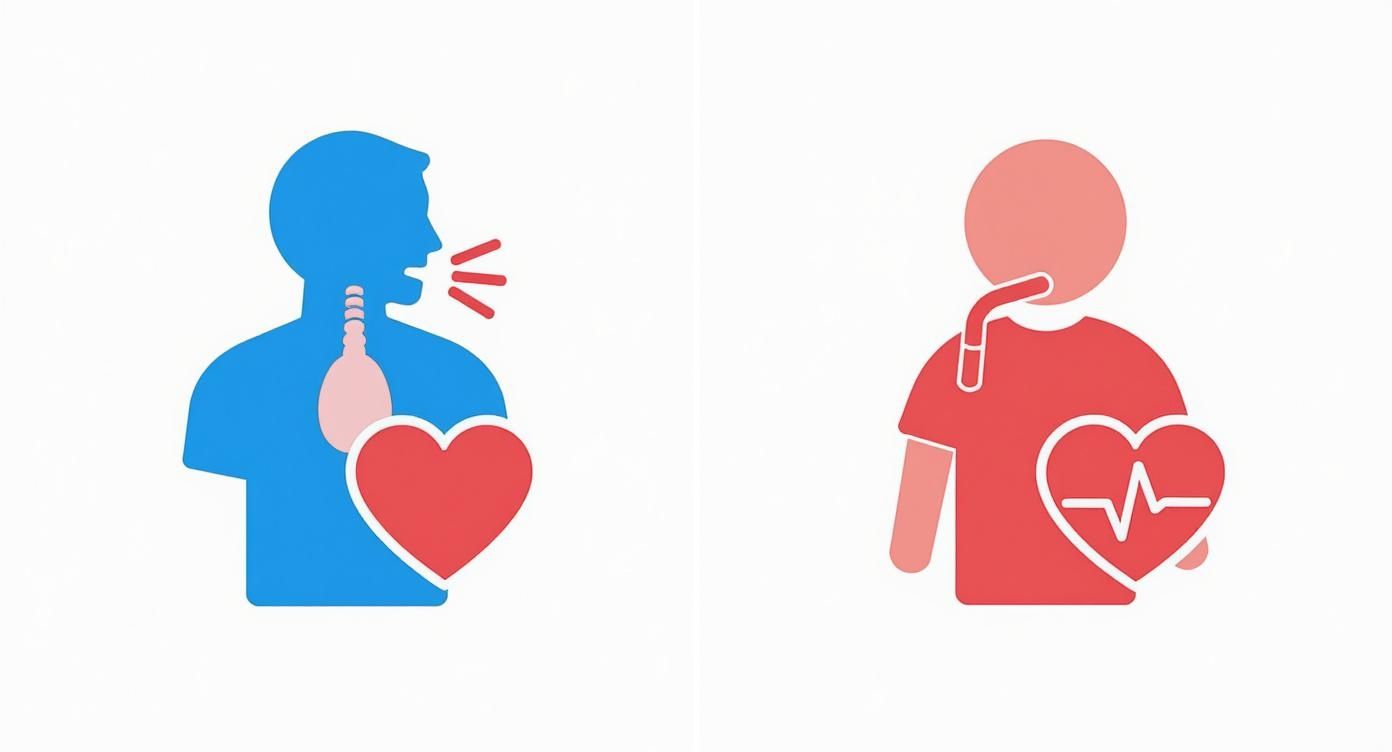
As you can see, a child’s smaller body and faster metabolism mean that our first aid approach needs to be carefully adapted.
A is for Airway
If the child is unresponsive, your immediate priority is their airway. A child’s airway is incredibly narrow and can become blocked very easily.
To check it, place one hand on their forehead and gently tilt their head back. At the same time, use the fingertips of your other hand to lift their chin. This simple “head-tilt, chin-lift” manoeuvre is often all it takes to open the airway and let air flow freely.
While doing this, take a quick look inside their mouth for any obvious blockages, like a piece of food or a small toy. If you can see something, carefully try to remove it. Never perform a blind finger sweep, as you risk pushing the object even further down their throat.
B is for Breathing
Once the airway is open, you need to check if they are breathing normally. Lean down and place your ear close to the child’s mouth and nose.
For up to 10 seconds, you must:
- Look for the rise and fall of their chest.
- Listen for the sound of breathing.
- Feel for their breath against your cheek.
This single check tells you whether you need to begin rescue breaths. Sometimes, just opening the airway is enough to get them breathing again. In complex emergencies, having an expert on hand is invaluable. It’s why our travel and emergency nannies are all trained to confidently handle these very scenarios.
C is for Circulation
Finally, check for signs of circulation. This means looking for signs of life—are they breathing normally, coughing, or making any movements? If the child is not breathing and shows no signs of life, it’s time to call 999 immediately and start CPR.
While the DRABC steps are universal, how you perform them on an infant versus a child differs slightly. This table breaks down the key distinctions.
DRABC Steps for Infants vs Children
| Step | Action for an Infant (<1 Year) | Action for a Child (>1 Year) |
|---|---|---|
| Danger | Same process for both: assess and secure the area. | Same process for both: assess and secure the area. |
| Response | Gently tap the sole of their foot. | Gently tap their shoulders and speak loudly. |
| Airway | Use a ‘neutral’ head position. Tilt the head back only slightly. | Perform a ‘head-tilt, chin-lift’ manoeuvre. |
| Breathing | Check for 10 seconds. Give 5 initial rescue breaths, covering their mouth and nose with your mouth. | Check for 10 seconds. Give 5 initial rescue breaths, pinching their nose and covering their mouth with yours. |
| Circulation | If no signs of life after rescue breaths, start chest compressions with two fingers in the centre of the chest. | If no signs of life after rescue breaths, start chest compressions with the heel of one hand in the centre of the chest. |
Mastering the DRABC method gives you a clear path to follow in a moment of chaos. It helps you turn panic into a structured, effective response, empowering you to be the calm, capable first aider a child needs you to be.
Handling Common Childhood Emergencies with Confidence
Once you’ve learned to assess a situation calmly, the next vital step is knowing how to act. Understanding how to manage the most common childhood emergencies is what turns that initial moment of fear into focused, effective action.
This is where all the theory clicks into place. From a sudden choking episode to an unexpected scald, your calm and correct response can stop a minor incident from escalating into something much more serious.
Childhood accidents are a stark reality in the UK. NHS figures show that over 2 million children under 15 have accidents in or around their homes every year, many of which require immediate first aid. Choking, falls, and burns top the list, which really brings home just how crucial these skills are. You can explore more on childhood accident statistics and prevention in the UK.
Responding to a Choking Emergency
Choking is one of the most frightening emergencies because it’s silent and happens incredibly fast. The technique you use is completely different depending on the child’s age, so it’s vital to know the distinction.
For an Infant (Under 1 Year Old)
A baby’s airway is tiny and delicate, so your approach needs to be gentle but firm. It’s critical to remember: never perform abdominal thrusts on an infant.
- Give 5 Back Blows: Lay the infant face down along your forearm, using your hand to support their head and jaw. Make sure their head is lower than their chest. With the heel of your other hand, deliver five firm blows right between their shoulder blades.
- Give 5 Chest Thrusts: If the back blows don’t work, carefully turn the infant over, keeping their head low. Place two fingers in the centre of their chest (just below the nipple line) and give five sharp thrusts.
- Repeat: Keep alternating between 5 back blows and 5 chest thrusts until the object comes out and they can breathe again, or until the emergency services take over.
For a Child (Over 1 Year Old)
If an older child is conscious but can’t cough or breathe, you’ll use a combination of back blows and abdominal thrusts.
- Encourage Coughing: First things first, get them to cough. It’s the body’s most effective way to clear a blockage.
- Give 5 Back Blows: If they can’t cough, stand behind them and lean them forward slightly. Give five sharp blows between their shoulder blades with the heel of your hand.
- Give 5 Abdominal Thrusts: Still choking? Stand behind them and wrap your arms around their waist. Make a fist with one hand, place it just above their belly button, and grasp it with your other hand. Pull sharply inwards and upwards.
- Repeat: Continue the cycle of 5 back blows and 5 abdominal thrusts until the object is cleared or help arrives.
Managing Burns and Scalds
A child’s skin is much thinner than an adult’s, which means it can be damaged by heat far more quickly and severely. Getting it right in the first few moments is key to minimising the injury.
The single most important treatment for any burn is cool running water. It does two jobs: it soothes the pain and, crucially, it stops the heat from continuing to damage deeper layers of skin.
Place the affected area under cool (not cold) running water for at least 20 minutes. Never use ice, creams, or greasy things like butter—these can trap the heat in and make the burn worse.
After cooling, cover the burn loosely with cling film or a sterile, non-fluffy dressing to keep it clean. You should always get medical advice for any burn that’s larger than a postage stamp, is on the face, hands, feet, or genitals, or if it looks blistered or white.
Controlling Serious Bleeding
Seeing a deep cut can be shocking, but the solution is straightforward: apply direct and consistent pressure.
- Apply Pressure: Grab a sterile dressing, a clean cloth, or even just your hands, and apply firm pressure directly onto the wound.
- Elevate the Limb: If the cut is on an arm or leg, raise it above the level of the heart. Gravity will help slow the blood flow to the injured area.
- Secure the Dressing: When the bleeding has slowed, wrap a bandage around the dressing to hold it in place. If blood soaks through, don’t take the first dressing off! Just add another one on top and keep applying pressure.
Handling a Febrile Seizure
A febrile seizure, which is a convulsion triggered by a high fever, is terrifying to watch. The good news is that they are usually harmless and are over in a few minutes. Your main job is to stay calm.
- Do Not Restrain: Move the child to a safe area on the floor, away from any hard furniture. Don’t try to hold them down or put anything in their mouth.
- Time the Seizure: Make a quick note of what time it started and when it stops.
- Cool Them Down: Gently loosen any tight clothing, especially around their neck.
As soon as the seizure is over, roll them into the recovery position and seek medical advice to find out what’s causing the fever. Mastering these core skills gives you the confidence to step in and make a real difference, ensuring the best possible outcome for the child in your care.
How to Choose a Paediatric First Aid Course
Knowing you need to learn paediatric first aid is the first step, but finding the right course is the one that really counts. With so many options out there, how do you know which provider will give you the genuine skills and confidence you need, and not just a piece of paper?
This isn’t about just ticking a box. It’s about being truly prepared for those heart-stopping moments when a child needs you most. Whether you’re a new parent looking for peace of mind or a childcare professional who needs to meet legal standards, the quality of your training is everything.
Worryingly, a recent St John Ambulance survey found that only 40% of people in the UK feel they have the first aid skills needed to save a life. This gap highlights just how vital it is to find training that builds real, lasting confidence. You can see the full findings on public first aid confidence in the UK.
Finding the Right Course Format
The first big decision is figuring out which course format will work best for your schedule and learning style. Each one has its own strengths, so it’s worth thinking about what you really need.
To help you decide, let’s break down the main options available for paediatric first aid training.
Comparing Paediatric First Aid Course Formats
| Course Format | Key Features | Best For |
|---|---|---|
| In-Person | Fully hands-on sessions in a classroom. Direct instructor feedback and practice on manikins. Group interaction. | Learners who thrive in a traditional classroom setting and want maximum practical experience and direct expert guidance. |
| Online-Only | Self-paced learning with digital modules, videos, and quizzes. Can be done from anywhere, anytime. | Individuals needing a basic theoretical refresher or those with extremely restrictive schedules. Not suitable for official certification. |
| Blended Learning | A hybrid approach. Theoretical content is covered online at your own pace, followed by a shorter, practical in-person session. | Professionals and busy parents who need flexibility but still want the crucial hands-on skills practice to build confidence. |
While online learning offers convenience, remember that first aid is a physical skill. Building the muscle memory to perform CPR on a tiny infant simply can’t be learned from a screen alone, which is why blended and in-person courses are usually the best bet.
What to Look for in a Quality Provider
Once you’ve settled on a format, the next step is to vet the provider. This is crucial—not all courses are created equal, and a few key signs can help you spot a genuinely high-quality training organisation.
When you’re comparing options, look for providers who use engaging and hands-on interactive training methods. You need a course that gets you moving and practising until the techniques feel like second nature, because passive learning just doesn’t cut it in an emergency.
Here are the key things to check for:
- Ofqual Regulation: This is the gold standard in the UK. An Ofqual-regulated qualification means the course provider has been independently audited and meets strict national standards. It’s a powerful mark of quality.
- Experienced Instructors: Who is teaching you matters. The best trainers often come from a paramedic, nursing, or long-term childcare background. A trainer who is also a parent can bring a whole other level of empathy and real-world understanding to the course.
- Plenty of Practical Equipment: You shouldn’t be spending your time waiting for a go on a manikin. A good course will have enough infant and child manikins for everyone to get plenty of hands-on practice without long delays.
The goal isn’t just to learn the steps; it’s to build the confidence to perform them under immense pressure. A good course focuses as much on building your self-assurance as it does on teaching the technical skills.
Choosing the right course is a big decision, but it doesn’t have to be a complicated one. By focusing on accredited, hands-on training delivered by experienced instructors, you can be sure your investment will pay off with real, life-saving confidence.
Keeping Your First Aid Skills Ready for Action
Learning paediatric first aid isn’t a “one-and-done” deal. It’s a perishable skill, a bit like muscle memory. If you don’t keep it active, the crucial details start to fade. The difference is, forgetting the right way to perform infant CPR has far greater consequences than fumbling a chord on a guitar.
That’s why looking after your skills is just as vital as taking the initial course. When a real emergency unfolds, there’s no time to flip through a manual. Your reaction has to be instinctive and sure-footed, and that kind of confidence only comes from keeping the knowledge at your fingertips.
A first aid certificate isn’t just a piece of paper. It’s a commitment to a child that you’re prepared to help. Honouring that commitment means ensuring your skills are sharp today, not just the day you passed the course.
Staying Current Beyond Certification
In the UK, most paediatric first aid certificates last for three years. While that ticks the official boxes, a lot can be forgotten in that time. Most seasoned first aiders and experienced parents will tell you that a regular, quick refresh is a brilliant idea.
You don’t have to retake the full course every year. It’s more about weaving small, simple habits into your routine that keep your skills sharp and your confidence up. It’s about cultivating a mindset of being always prepared.
Here are a few easy ways to keep your knowledge topped up:
- Use First Aid Apps: Download a trusted app from organisations like the NHS or St John Ambulance. They’re fantastic for quick, visual refreshers on common emergencies that you can glance at in spare moments.
- Watch Refresher Videos: A five-minute video on the infant choking technique can be a powerful and effective reminder. Why not set a calendar alert to watch one every few months?
- Practise with Family: Walk through a “what if” scenario with your partner. Talking through the steps of DRABC or role-playing how you’d treat a minor burn helps lock the process in your memory.
Building Your Practical Toolkit
Being mentally prepared is half the battle; having the right tools is the other. A well-stocked, easy-to-grab first aid kit is non-negotiable in any home with little ones. It stops a minor drama from turning into a major panic while you hunt for a plaster.
Make sure your kit is built with children in mind. That means having smaller plasters, child-friendly antiseptic wipes, and any specific medications your child might need.
Here are the essentials for a child-focused first aid kit:
- A digital thermometer
- Assorted waterproof plasters and sterile dressings
- Antiseptic wipes and hand sanitiser
- Tweezers for splinters
- Child-safe scissors
- Cling film for covering burns
- Children’s paracetamol or ibuprofen
- An instant ice pack
Pop a reminder in your calendar to check your kit every six months. You can replace anything you’ve used and make sure the medicines are still in date. This simple habit ensures you’re not just mentally ready, but physically equipped to handle whatever comes your way.
Got Questions About Paediatric First Aid? We’ve Got Answers.
Even with a good grasp of the basics, a few questions nearly always pop up. That’s completely normal. Let’s tackle some of the most common queries we hear from parents and carers, giving you clear, straightforward answers to boost your confidence.
Think of this as your go-to guide for those nagging “what if?” moments. Getting these details sorted is the final piece of the puzzle, making sure you feel truly prepared for anything.
When Do I Switch from Infant to Child Techniques?
This is a big one, and it causes a lot of confusion. When exactly does a baby stop being an ‘infant’ in first aid terms and become a ‘child’? Thankfully, the answer is simple and consistent across all official training.
The changeover happens on their first birthday. An ‘infant’ is a baby from birth up to one year old. A ‘child’ is anyone from their first birthday right up until puberty kicks in.
It’s a crucial distinction because an infant’s body is incredibly delicate. The way you perform CPR, handle choking, or even open their airway is specifically adapted for their tiny, fragile frame. After they turn one, their bones and overall resilience have developed enough to withstand the slightly different techniques used for older children.
What Are the First Aid Rules for UK Nurseries and Schools?
Handing your child over to a nursery or school is a huge act of trust. You need to know they’re in a safe pair of hands. The good news is that UK law is very specific about this, laid out in the Early Years Foundation Stage (EYFS) statutory framework.
For early years providers like nurseries and childminders, the rules are non-negotiable:
- There must be at least one person with a current paediatric first aid (PFA) certificate on-site and available whenever children are there.
- That same certified person has to go with the children on any outings or trips.
- All newly qualified staff are also required to hold a full PFA certificate.
This setup ensures that no matter what happens or when, someone with the right training is ready to step in immediately.
Are Online-Only First Aid Courses Valid?
With so much learning moving online, it’s a fair question: can you get properly certified just by completing a course on your laptop? For official UK qualifications, the answer is a firm no.
While the theory part of a course works brilliantly online, paediatric first aid is a hands-on, physical skill. You can’t learn to save a life just by watching videos. Regulatory bodies like Ofsted and the EYFS insist on a practical assessment where you prove you can perform CPR and back blows on manikins.
So-called ‘blended’ courses are the perfect solution. You get the flexibility of learning the theory online in your own time, followed by an in-person session to master and be assessed on the practical skills. These are fully recognised and offer the best of both worlds.
What Should I Put in a Baby’s First Aid Kit?
A standard first aid kit is a great starting point, but a kit for a baby or toddler needs a few extra, specialised items.
Make sure your kit is stocked with:
- A digital thermometer – you need accurate readings.
- Liquid paracetamol or ibuprofen specifically for children.
- Smaller plasters and dressings that will actually fit tiny fingers.
- Saline drops or a spray to help clear a blocked, stuffy nose.
- Gentle antiseptic wipes that won’t irritate sensitive skin.
Having these essentials packed and easy to find means you can deal with little bumps and illnesses calmly and quickly, giving your little one the comfort they need right away.
For families who accept nothing less than the best, checking that your nanny or childcarer has up-to-date paediatric first aid training is essential. At Superstar Nannies, we meticulously check every single candidate to ensure they have the qualifications and practical skills needed to create a safe, secure, and nurturing home for your children. Learn more about our commitment to five-star service and peace of mind.